
The Myth
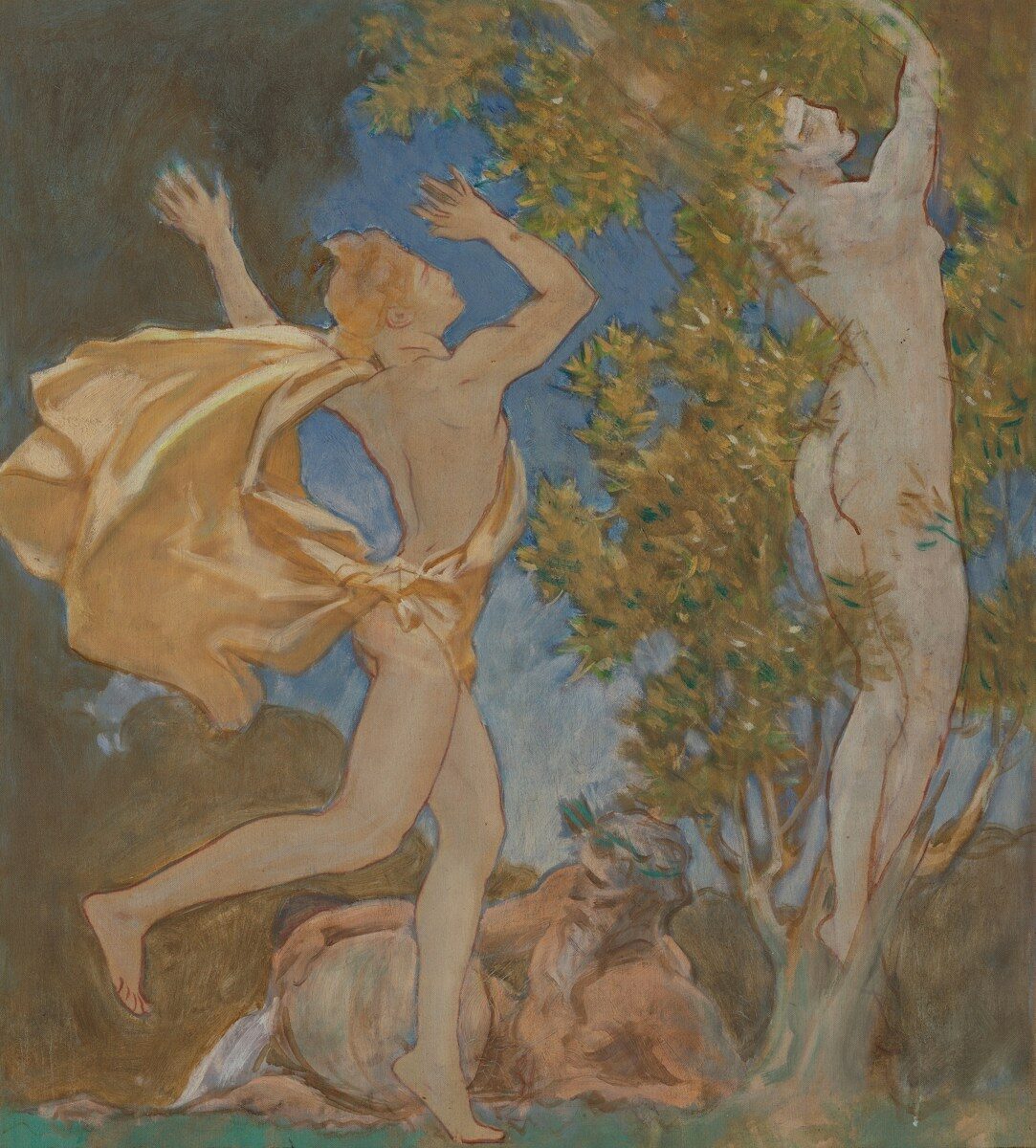
Ker-Xavier Roussel, Apollo and Daphne
There is a story from Greek mythology that most of us encounter once in a school textbook and then quietly forget. It involves a god, a nymph, and a laurel tree. But sit with it long enough, and it stops feeling like a myth about pursuit. It starts feeling like a myth about nature itself — and what it means to become part of it.
The myth does not begin with love. It begins with ego. Apollo mocks Eros for carrying a bow and arrow. Eros retaliates with two arrows — one tipped in gold, igniting in Apollo a consuming obsession with the nymph Daphne; the other tipped in lead, filling Daphne with a bone-deep revulsion toward pursuit. Neither of them chose this. But only one will be transformed by it.
Apollo pursues Daphne through the woods, calling out his divinity and status as she runs. She does not stop. She runs until her lungs burn and her legs grow heavy, every breath costing more than the last. She is, in the most literal sense, running out of herself.
With Apollo’s breath on her neck, Daphne prays to her father Peneus to take her form entirely. What follows is one of the most visceral transformation sequences in classical literature. Ovid describes it with extraordinary physical detail: a heaviness seeps into her limbs, bark closes over her skin, her hair erupts into leaves, her arms stretch into branches, her feet root into the earth and go still.
This is not a clean metamorphosis. It moves through her the way a tree actually grows — slowly, from the inside out. Every part of her human body finds a natural counterpart: skin to bark, hair to foliage, bones to wood, breath to the rustling of leaves. Nature does not erase her. It absorbs and translates her into something older and more enduring.
That threshold image has obsessed artists for centuries. Bernini’s 1625 marble captures the precise instant of change — fingers already branching into leaves, bark creeping up her thigh, her face still turned in anguish. Painters from Pollaiuolo to Tiepolo returned to the same suspended moment: not the chase, not the aftermath, but the in-between, when a human being and a living tree are the same thing.
By merging with the earth, Daphne becomes something Apollo’s hands cannot hold. She trades mobility for permanence, voice for the language of leaves, warmth for the deep stillness of root and soil. Her natural form makes her untouchable in a way her human form never could.
Apollo declares the laurel his sacred symbol, and her transformed body becomes the crown of heroes and poets — the word laureate carries her name to this day. She never fully escapes him. But rooted in the earth, bark where her skin once was, leaves where her voice once was, she remains what she always wanted to be: wild, and entirely her own.
WORK CITED
Ovid, Metamorphoses, Book I
Bernini, Gian Lorenzo. Apollo and Daphne, 1622–1625. Galleria Borghese, Rome
Pollaiuolo, Antonio del. Apollo and Daphne, c. 1470–1480. National Gallery, London
The myth of Galatea
Galatea There is a story most people remember as a love story. A sculptor creates the perfect woman from ivory, prays for her to be made real, and gets exactly what he asks for. It sounds like a miracle. It is told like a romance. But look at it from the other...