
Galatea
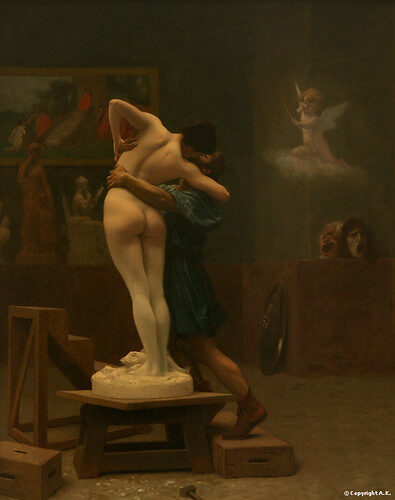
There is a story most people remember as a love story. A sculptor creates the perfect woman from ivory, prays for her to be made real, and gets exactly what he asks for. It sounds like a miracle. It is told like a romance. But look at it from the other side–from inside the stone–and it becomes something else entirely.
Pygmalion, offended by the vices he perceived in real women, chose to live without one. Instead, he sculpted white ivory with extraordinary skill and gave it a form he believed no living woman could possess. He dressed her, brought her gifts, laid her in his bed. Her appearance was that of a true maiden–so lifelike you might have thought her alive, and wished her to move.
This is where the myth asks you to find it romantic. But what Pygmalion built was not a relationship. It was a projection. He did not fall in love with a person. He fell in love with the absence of one–with a body that could not disagree, could not leave, could not want anything he had not carved into her.
When Aphrodite’s festival came, Pygmalion made his offering and prayed. Aphrodite breathed life into the statue, and Galatea became a living woman. In Ovid’s telling, this is the happy ending. The ivory warms, the pulse begins, and Pygmalion gets what he wanted.
But Ovid never asks what Galatea wanted. In the original myth, Galatea does not speak at all and is not even given a name–she is only called “the woman,” an object of desire and nothing more. Her transformation from stone to flesh is treated as a gift. It is never considered that waking up already claimed and named by the man who made you might feel less like a miracle and more like a different kind of imprisonment.
This is precisely where Madeline Miller begins. Her 2022 retelling reimagines the myth through Galatea’s own eyes, touching on bodily autonomy, purity, perfection, and the dynamics of gendered power. Miller’s story picks up after the supposed happy ending, with Galatea trapped in a hospital by her husband–not because she is ill, but because she tried to run. Pygmalion is never named in the retelling, referred to only as “my husband”–a man who keeps her locked away and her personhood treated as a problem to be managed.
The metamorphosis in Miller’s version runs in reverse. The myth begins with stone becoming flesh. Miller asks what happens when a living woman is slowly pressed back into stillness.
The story of Galatea is, at its core, about the danger of being created entirely in someone else’s image. Pygmalion did not want a woman. He wanted a surface that he could call his own, perfect and silent. The transformation Aphrodite granted gave Galatea a heartbeat, but not the freedom that should come with one.
The myth is called Pygmalion because it was never meant to be her story. She never claims an identity for herself; society denied her even a name for centuries. Miller gives it back. And in doing so, she asks the question Ovid never bothered with: what does it feel like to wake up already belonging to someone else?
The answer, it turns out, looks nothing like love.
Work Cited
Ovid, Metamorphoses, Book X.
Miller, Madeline. Galatea. Ecco Press, 2022.
Girodet, Anne-Louis. Pygmalion and Galatea, 1813–1819. Musée du Louvre, Paris.